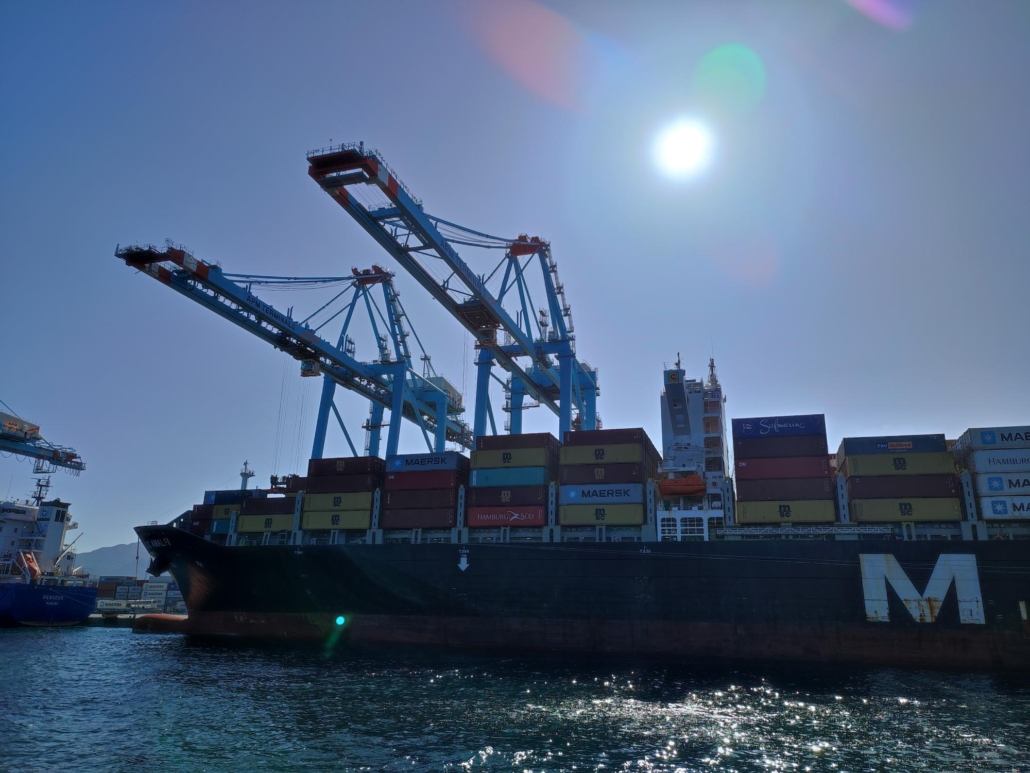
The Role of the Spanish Ports in Today’s Global Landscape
In a context of geopolitical uncertainty marked by international conflicts and some crises inherited from 2024, Spanish ports have acquired a strategic role. Spain, with its consolidated maritime tradition, has become a key logistics hub within Europe, positioning itself as a global trade reference due to its geographical location and connectivity.
This is reflected in the growing economic impact of Spain’s general interest ports, which have significantly increased their contribution in recent years. According to a study on the economic impact of Spanish ports, they generate 24.3 billion euros and support 250,000 jobs, accounting for 2.2 percent of national GDP and 1.4 percent of total employment. Spain’s strategic position, at the crossroads of Europe, Africa and America, further reinforces its global logistics significance. The Strait of Gibraltar alone handles between 10 and 25 percent of global maritime trade, consolidating Spanish ports as critical infrastructures in international shipping routes.
Among the Spain’s main ports, the following stand out:
- Santander/Bilbao: Essential for trade with the UK and Northern Europe.
- A Coruña/Vigo: Key connections with the Americas, while facilitating north-south trade between Europe and Africa.
- Algeciras: Spain’s largest port and one of Europe’s top transshipment hubs, maintaining critical links with Africa, the Americas and Asia.
- Valencia: A leading container port, with strong commercial ties to China and Southeast Asia.
- Barcelona: A crucial gateway to the Mediterranean and North Africa, with historically high cargo volumes.
This being so, recent geopolitical changes have significantly impacted Spanish ports, compelling them to redefine strategies and adjust priorities in response to new global challenges.
- US-China tensions. The expansion of China’s Maritime Silk Road has reinforced Beijing’s presence in the Mediterranean, reshaping trade dynamics. In 2025, new sanctions and ongoing technological disputes could disrupt trade flows, potentially affecting Spanish exports to Asia.
- The war in Ukraine and NATO expansion. The energy crisis has shifted trade benefits toward Mediterranean ports, often at the expense of Northern European hubs. Spain has capitalized on this shift by positioning itself as a key LNG importer from the Americas and Africa, leveraging agreements such as the EU-Egypt-Israel trilateral memorandum on natural gas exports to Europe.
- The Panama Canal crisis. A potential political crisis or rising transit costs through the Panama Canal could pose challenges for Valencia, Barcelona and Algeciras, which rely heavily on the canal for trade with South America’s Pacific coast. Any disruption could affect rout viability and overall trade volumes.
- Decarbonisation and the EU Green Deal. The shift towards a more sustainable maritime transport presents challenges. Spanish ports must adapt to stricter CO₂ regulations while ensuring they remain competitive in global trade.
In order to maintain their global position, Spanish ports must focus on key strategic areas. Investing in modern infrastructure and digitalisation will be essential for adapting to evolving technological and environmental regulations. Strengthening rail and logistics connectivity will enhance landside efficiency and improve cargo distribution. Additionally, expanding the Green Maritime Corridor in 2025 will further consolidate Spain’s role in sustainable global trade.
Spanish ports must continue evolving towards a more sustainable, technologically advanced mode, fully integrated into international logistics networks.
Only by doing so will they successfully face current and future geopolitical and economic challenges, consolidating their position as key players in global trade.